Have you ever been cruising down I-225 or heading home through the stop-and-go traffic on Havana Street when you heard a faint, high-pitched chirp every time you hit the brakes? It’s a common scenario for many drivers in Aurora, and often, it is the first “voice” your car uses to tell you something is wrong. While it might seem like a minor annoyance, that sound is actually a critical safety warning designed to save you from a much larger repair bill.
At Value Tires & Service, we believe in being upfront with our community. Brake maintenance isn’t just about stopping; it’s about protecting your investment. Your braking system is a team effort between brake pads, calipers, and rotors. When the pads wear down too far, they stop being a protective cushion and start acting like sandpaper against your expensive metal rotors.
Understanding the warning signs of brake wear can be the difference between a simple, affordable maintenance visit and a major overhaul. Here are the five primary signs that your brake pads are calling for help.
1. That Piercing Squeal or Screech
The most frequent sign of worn brake pads is a high-pitched squeal or screeching noise that occurs when you apply the brakes. This isn’t a fluke or a sign of “cold brakes” in our Colorado winters; it is a deliberate engineering feature.
Most modern brake pads are manufactured with a “wear indicator”: a small metal tab that becomes exposed as the friction material wears down. When the pad reaches a critically low level, this metal tab scrapes against the rotor, creating that unmistakable sound. Think of it as your car’s built-in alarm clock telling you it’s time for a brake pad replacement.

If you hear this sound, there is still time to act before damage occurs. However, ignoring it will lead to the friction material disappearing entirely, which brings us to a much more serious symptom.
2. The Dreaded Metal-on-Metal Grinding
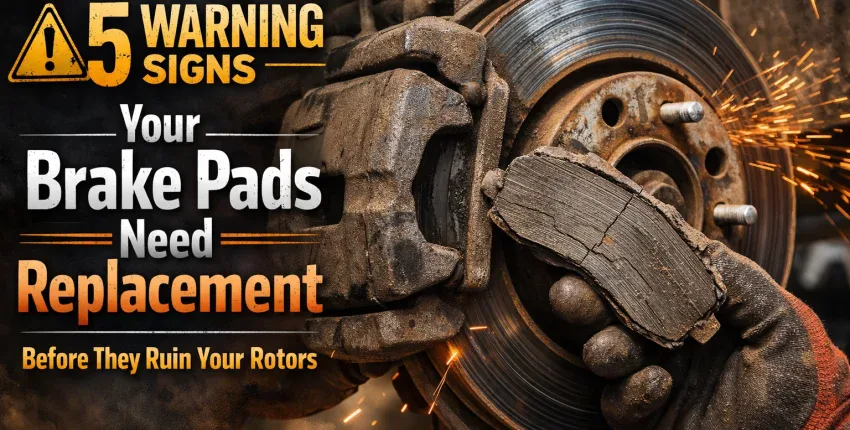
If the squealing has stopped and has been replaced by a deep, harsh grinding or growling noise, you have entered the “danger zone.” This sound typically means that the friction material on your brake pads is completely gone.
At this stage, the metal backing plate of the brake pad is pressing directly against the metal brake rotor. This is a “metal-on-metal” situation that causes immediate and severe damage. Not only does this significantly reduce your ability to stop safely in an emergency, but it also gouges the surface of the rotors.
In Aurora, where we deal with sudden mountain storms and unpredictable traffic, having compromised stopping power is a major safety risk. From a financial perspective, catching wear at the “squeak” stage might cost you $150 to $300 for a pair of pads. Waiting until the “grind” stage can easily double or triple that cost because you will likely need to replace the rotors and potentially the calipers as well.
3. Increased Stopping Distances (Brake Fade)
Have you noticed that you have to start braking much earlier when approaching a red light on Colfax Avenue? Or perhaps you feel like you have to push the pedal much closer to the floor than you used to? This phenomenon is known as “brake fade” or a loss of performance.
As brake pads wear down, they lose their ability to dissipate heat effectively. In the Denver metro area, our elevation and hilly terrain already put extra stress on braking systems. Worn pads struggle to create the necessary friction against the rotor, especially during repeated use in heavy traffic.
If your car doesn’t respond with the crispness it once had, it’s a clear indicator that the pads are no longer fit for service. This is a critical safety issue. In an emergency situation, those extra few feet of stopping distance can be the difference between a close call and a collision. Our ASE certified technicians in Aurora can perform a comprehensive vehicle diagnostic to determine if your pads are the culprit or if there is air in your hydraulic lines.

4. Pulsation or Vibration in the Pedal
When you step on the brake pedal, the sensation should be smooth and firm. If you feel a rhythmic pulsing, shaking, or vibration through the pedal: or even through the steering wheel: it usually points to a problem with the rotors.
While this article is about brake pads, the two are inextricably linked. Vibration often occurs because the rotors have become “warped” or have developed uneven spots due to extreme heat. Often, this heat is caused by thin brake pads that can no longer insulate the rest of the system.
Driving with vibrating brakes isn’t just uncomfortable; it’s hard on your suspension system and can lead to uneven tire wear. If you’re feeling a pulse, it’s time to have a professional look at the entire assembly to see if the rotors can be “resurfaced” (smoothed out) or if they need to be replaced entirely.
5. Visual Inspection: The 1/4 Inch Rule
You don’t always have to rely on your ears or your “gut feeling” to know if your brakes are worn. For many vehicles with alloy wheels, you can actually see the brake pads without even taking the wheel off.
Look through the spokes of your wheel and locate the circular metal rotor. Pressed against it, you will see the brake caliper, and inside that caliper is the brake pad.
- The Rule of Thumb: If the friction material (the part of the pad touching the rotor) looks to be less than 1/4 inch thick (about 6.4mm), you should start planning for a replacement soon.
- The Emergency Level: If the pad looks to be 1/8 inch or less, you are at risk of rotor damage and should seek brake repair in Aurora, CO immediately.

Why Aurora Drivers Experience Faster Brake Wear
Vehicle maintenance isn’t “one size fits all.” Here in Aurora and the surrounding Denver area, our environment plays a significant role in how long your brakes last.
- Temperature Extremes: We go from freezing winters to scorching summers. This constant expansion and contraction of metal components can accelerate wear.
- Mountain Driving: Frequent trips up and down the I-70 corridor require heavy braking. Continuous downhill braking generates immense heat, which can “glaze” brake pads, making them less effective even if they still have thickness left.
- Stop-and-Go Traffic: Aurora’s growth means more traffic on roads like E-470 and Mississippi Ave. Constant stopping is much harder on pads than highway cruising.
The Value of Preventative Maintenance
At Value Tires & Service, we focus on “Comparative Logic.” We want our customers to understand the math:
- Preventative Path: A set of new brake pads and a quick inspection by an ASE-certified technician. (Lower cost, higher safety, takes about an hour).
- Neglect Path: Waiting until the grinding starts. This leads to new pads, new rotors, potential caliper repair, and labor for a more intensive job. (Higher cost, potential towing fees, vehicle downtime).
Choosing the preventative path is simply the honest, smart way to manage your car. We aren’t here to upsell you on parts you don’t need; we’re here to ensure that when you need to stop, your car listens.
Trust the Experts at Value Tires & Service
If you’ve noticed any of these signs: the squealing, the vibration, or the longer stops: don’t wait for the sound to get louder. Our team of ASE certified technicians in Aurora is dedicated to providing honest, transparent service. We will show you exactly how much life is left in your pads and give you a straight answer on whether you can wait or if it’s time for a change.
Safety on our Colorado roads starts with a reliable braking system. Whether you need a quick inspection or a full brake pad replacement, we’re here to help you stay safe and save money in the long run.
Ready for a check-up? Contact us today or stop by our shop in Aurora to ensure your vehicle is ready for whatever the road throws your way.