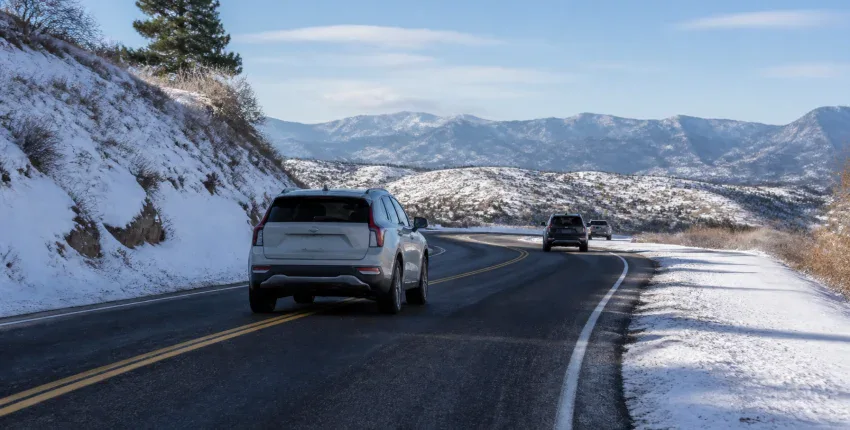
Planning to drive from Aurora or Denver into the mountains this fall or winter? Before you point your vehicle toward I-70, ask yourself two questions: Do your tires meet Colorado’s traction requirements, and are your brakes ready for a long, steep descent?
Colorado’s Passenger Vehicle Traction Law officially went into effect on September 1, 2026, and remains active through May 31. On the I-70 mountain corridor between Morrison and Dotsero, drivers must be prepared to meet the law’s requirements when traveling through winter conditions. A little preparation can help you avoid a fine, a dangerous loss of traction, or getting stuck on the pass.
At Value Tires & Service, we check tires and brakes together so drivers can leave Aurora with a clearer picture of their vehicle’s mountain readiness.
What Colorado’s Traction Law Requires on I-70
Colorado’s traction requirements apply along the I-70 mountain corridor from Morrison to Dotsero during the traction-law season. Depending on the vehicle and its equipment, drivers generally need one of the following:
- Tires with at least 3/16 inch of tread depth and a qualifying M+S, M/S, M&S, winter, or all-weather designation
- Tire chains or an approved alternative traction device on the required drive tires
The 3/16-inch measurement is more than a suggestion. Tires that look acceptable for ordinary city driving may not meet the legal minimum for the mountain corridor, especially after months of wear from dry pavement, potholes, and temperature changes.
Colorado’s official traction-law guidance is the best place to review current rules, restrictions, and conditions before a trip. Requirements can also change when severe weather or roadway conditions develop.
AWD does not automatically satisfy the law
All-wheel drive and four-wheel drive can help a vehicle transfer power to the road, but neither system replaces proper tires. An AWD vehicle still needs qualifying tires with the required tread depth, or it must use chains or an approved alternative traction device when applicable.
This is an important distinction. AWD may help you accelerate on snow, but it does not automatically help you stop, steer, or comply with Colorado’s traction requirements. Your tires are still the only part of the vehicle making direct contact with the road.
Drivers with two-wheel-drive vehicles should pay especially close attention. Current Colorado guidance includes additional chain or approved alternative traction device carry requirements for many 2WD passenger vehicles traveling west of Morrison during the traction-law season.
Check Your Tread Before You Leave Aurora
Tread depth is one of the simplest things to check before a mountain trip. You can start at home, but a professional inspection is useful when the measurement is close to the limit or the tires show uneven wear.
Try the penny test
Insert a penny into the tire’s tread groove with Lincoln’s head facing downward. If you can see the top of Lincoln’s head, the tread may be near or below 2/32 inch, which is the commonly used replacement threshold for general tire safety. However, Colorado’s traction-law minimum is 3/16 inch, or 6/32 inch, so the penny test is not enough to confirm legal compliance.
For I-70 travel, have all four tires measured with a tread-depth gauge. Tread should also be relatively even across the tire. One tire worn much more than the others may indicate an alignment, suspension, inflation, or rotation problem.
Look for the wear bars
Most passenger tires have built-in wear bars running across the tread grooves. These raised sections indicate that the tire is approaching the manufacturer’s minimum wear limit when the surrounding tread becomes level with them.
Do not wait until the wear bars are flush if you plan to drive in snow. Mountain trips require more usable tread for traction, and a tire can be legal for ordinary driving while still being a poor choice for steep, snowy roads.
Also inspect the sidewalls for bulges, cuts, or cracking. A tire with adequate tread can still be unsafe if its structure has been damaged.
Check Tire Pressure as Temperatures Drop
Cold weather affects tire pressure. A commonly used guideline is that tire pressure drops by approximately 1 PSI for every 10°F decrease in temperature. A tire that was properly inflated during a warm September afternoon may be underinflated on a freezing morning in the mountains.
Check pressure when the tires are cold, preferably before driving. Use the pressure listed on the driver’s door-jamb label rather than the maximum pressure printed on the tire’s sidewall.
Proper inflation helps with:
- Steering response and stability
- Braking performance
- Even tread wear
- Fuel economy
- Reduced risk of tire damage
Do not reduce pressure to gain traction in snow. Lowering pressure can make the vehicle handle poorly and may damage the tire or wheel. If your tire-pressure monitoring light comes on, have the pressure checked and look for a puncture or slow leak.
You can schedule tire service and wheel alignment in Aurora at Value Tires & Service. An alignment check is especially worthwhile if the vehicle pulls to one side, the steering wheel sits off-center, or the tread is wearing unevenly.
Have Your Brakes Inspected Before Descending I-70
Many drivers think about traction while climbing into the mountains but forget how hard the return trip can be on the braking system. Descending I-70 grades requires repeated braking, often in traffic and on changing pavement. That heat and friction place significant stress on brake pads, rotors, and related components.
A brake inspection before a mountain trip can identify problems such as:
- Thin or unevenly worn brake pads
- Grooved, cracked, or heat-damaged rotors
- Brake fluid leaks or contamination
- Sticking calipers
- A soft or spongy brake pedal
- Excessive vibration during braking

If you hear grinding, feel pulsation through the steering wheel, notice a longer stopping distance, or smell a sharp burning odor after braking, do not ignore it. These symptoms can become more serious: and more expensive: under mountain-driving conditions.
When descending, use a lower gear when appropriate and avoid riding the brake pedal continuously. Controlled braking with time to cool between applications is generally easier on the system than dragging the brakes for miles. Still, driving technique cannot make up for worn pads or damaged rotors.
Our brake and rotor service includes brake inspections, pad replacement, rotor service, and brake-system checks. We explain what we find and recommend only the work needed for safe operation.
A Practical I-70 Readiness Checklist
Before heading from Aurora or Denver toward the Eisenhower-Johnson Memorial Tunnels, Vail, or another mountain destination, check the following:
- Confirm every tire has at least 3/16 inch of tread for traction-law compliance.
- Look for M+S, winter, all-weather, or mountain-snowflake markings.
- Verify tire pressure while the tires are cold.
- Inspect for uneven wear, sidewall damage, punctures, or bulges.
- Make sure your spare tire, jack, and tools are usable.
- Carry chains or an approved alternative traction device if your vehicle or the conditions require them.
- Test your brakes for noise, vibration, a soft pedal, or reduced stopping power.
- Check current conditions through COtrip.org before leaving.
- Allow extra following distance and avoid abrupt steering or braking on snow and ice.
Remember that a traction-law violation can cost around $100 plus surcharge, according to current Colorado guidance. If a vehicle becomes stuck and causes a lane closure, the penalty can rise to approximately $500 plus surcharge. More importantly, losing traction on a mountain corridor can put you, your passengers, and other drivers at risk.
Get an Honest Tire and Brake Check in Aurora
You do not need to guess whether your vehicle is ready for I-70. Value Tires & Service provides straightforward tire and brake inspections for drivers in Aurora, Denver, and nearby communities. Our ASE-certified technicians Aurora drivers rely on can measure tread, check inflation, inspect brake components, and explain your options without pushing unnecessary repairs.
As a family- and minority-owned shop with more than 30 years of combined experience, we focus on practical service and clear assessments. If your tires are still usable, we will tell you. If your brakes need attention before a mountain trip, we will explain why.
Schedule a tire and brake inspection before your next I-70 drive, or visit our contact page to reach Value Tires & Service at 2200 S Havana St, Unit 102, Aurora, CO. Getting prepared early is safer, and it may help you avoid the higher cost of an emergency repair: or a stranded vehicle on the pass.